Showing posts with label Book Review. Show all posts

Sunday, January 17, 2010

Book Review: The Artist's Guide to Sketching

I looked for James Gurney's new book at the Dallas library. I didn't find it, but I did find this book: The Artist's Guide to Sketching by James Gurney and Thomas Kinkade (1988). Yes, the Thomas Kinkade. Turns out Gurney and Kinkade were roommates at Berkley.

This book chronicles a road trip Gurney and Kinkade took one summer. Along the way, they did a bunch of on-the-spot sketching. This book shares their tricks-of-the-trade and drawings. The book covers the following topics:

  • Sketching in public (Logistics, dealing with people, being inconspicuous.)
  • Materials (How to keep it simple. Pencils, pens, markers, and wash are favored.)
  • Achieving accuracy (Start with pencil. Big forms before detail. Tips on perspective. Pen, marker and wash last.)
  • Capturing motion (Best treatment of gesture drawing I have ever seen.)
  • Creating mood.
  • Using imagination (We are not cameras, folks!)
  • Studying nature.
  • Sketching people.
  • Sketching man-made objects and structures, such as buildings.
  • Fitting sketching into your life

This book is inspirational and full of useful advice. I put this book in the same quality category as Bert Dodson's Keys to Drawing and Drawing with Imagination. This book is no longer offered new, but is available used. Used prices range from $45.00 to $315.00. These prices attest to the value of the book.

Here are my initial attempts at doing more comprehensive sketching and at using marker for values. Marker is a whole lot faster than pencil.


Tuesday, December 1, 2009

Book Review: Sketch Book


Just finished reading Sketch Book: Conceptual Drawings from the World's Most Influential Designers by Timothy O'Donnell. The book profiles a number of different designers and shows pages from their sketch books. The focus is on graphic design, not illustration or fine art. The book is interesting in that the subjects use their sketch books as a thinking tool, not as objects of art. No pretty pictures here. I got the book from the library. I wouldn't buy it, but it is worth checking out from the library. It provides food for thought on how to make good use of a sketch book.

Tuesday, April 21, 2009

Book Review: Teach Yourself Visually Drawing


I came across this book at my local library: Teach Yourself Visually Drawing by Dean Fisher and Josephine Robinson (Wiley, 2008). I am always on the lookout for new drawing books, so I checked it out. It is excellent.

The book takes an atelier approach to drawing. In fact, many of the drawings remind me of drawings in Classical Drawing Atelier by Juliette Aristides. Teach Yourself Visually Drawing, however, is a little more down-to-earth and accessible. For example, Teach Yourself Visually Drawing has numerous step-by-step demonstrations.

Teach Yourself Visually Drawing has the following chapters:
  1. What is Drawing?
  2. Drawing Materials
  3. In the Studio
  4. Prepare to Draw
  5. Discover the Pattern of Light and Shadow
  6. Introduction to One-Point Perspective
  7. Add More Dimension to Your World: Two-Point Perspective
  8. Discover the Potential of Line
  9. Planar Rendering of Complex Forms
  10. Draw a Plaster Cast
  11. The Portrait
  12. Drawing the Human Figure
  13. The Landscape

Most chapters end with a gallery of drawings. The drawings are by a variety of artists and are just exquisite. Very inspiring.

Teach Yourself Visually is evidently a whole series of books (e.g., Teach Yourself Visually Knitting, Teach Yourself Visually Guitar, Teach Yourself Visually Windows XP). The marketing slogan is "Read Less-Learn More". The idea is to learn by looking at pictures rather than by reading. This sounds intriguing, but in reality, most art books teach by showing art in various stages of completion. This book is good not because it has more pictures and fewer words than other art books, but rather because of the classical approaches it teaches and the exquisite drawings used to illustrate the techniques.

Saturday, January 3, 2009

The Man Who Made Vermeers


I just finished reading The Man Who Made Vermeers by Jonathan Lopez, which is yet another book on master forger Han van Meegeren. Han van Meegeren was the Dutch artist who successfully forged Vermeer paintings at the time of World War II. There is another recent book on van Meegeren, The Forger's Spell by Edward Dolnick. I reviewed The Forger's Spell here back in November.

The Man Who Made Vermeers and The Forger's Spell tell the same basic story.

The Forger's Spell provides a panaramic view of World War II history, art forgery, art history, and van Meegeren. It is an easy read and paints Han van Meegeren in a sympathetic light.

The Man Who Made Vermeers, on the other hand, focuses more on the forger himself and provides a scholarly treatment of the subject. Lopez portrays van Meegeren as a Nazi collaborator who didn't swindle the Nazis as a political statement, but rather swindled them because he was a forger and forgers are in the business of swindling their customers. According to Lopez, the myth of Han van Meegeren as heroic forger has persisted for so long because much of the evidence against him is in Nazi artifacts that are hidden from public view, either by law in Germany or by good taste in other Western countries. The evidence against him simply wasn't accessible. Lopez also makes interesting observations around the psychology of forgery. By today's norms, the forged Vermeers are very bad and are obviously fake. Lopez shows examples of Nazi art and shows how the fakes borrowed elements from Nazi art. This appealed to Nazi buyers on a subconscious level. In general, forgers make their forgeries appeal to the modern eye in some way. As time passes and culture and norms change, the fakes become obvious because viewers are no longer immersed in the culture of the forger's day.

I recommend this book. It is not as easy a read as The Forger's Spell, but is probably more truthful.

Monday, November 17, 2008

The Forger's Spell


I just finished The Forger's Spell by Edward Dolnick. It was a page turner. I got it from the library on Friday evening, and I finished it at 11:30 pm on Saturday. The book tells the story of Han van Meergeren, a Dutch artist who forged Vermeer paintings at the time of World War II. The book weaves together several threads:
  • The Nazi occupation of Denmark.
  • The Nazi obsession with acquiring (a.k.a. stealing) European art treasures.
  • The science and craft of forgery (e.g., purchase a mediocre, relatively inexpensive painting from the correct time period and paint over it, so scientific tests on the canvas will check out).
  • The psychology of forgery (e.g., Art historians really, really wanted to believe they had found a lost Vermeer. This enabled them to completely overlook the fact that the forged paintings were pretty bad.)
  • Art collectors' obsession with rarity over aesthetics (e.g., Wealthy art collectors sometimes want a painting so no one else can have it and for the prestige, not because the art speaks to them in some way.)

Rather than copying a known Vermeer or creating a "lost" Vermeer in the style of Vermeer's mature period, Van Meergeren created "lost" Vermeer paintings in a new style that could plausibly be between Vermeer's early and late periods. Because there are so few Vermeer paintings, there could be a whole period of lost paintings. The fact that so little is known about Vermeer made the forgery easier. Van Meergeren managed to sell a number of fake Vermeer paintings before he was caught. Interestedly, once Van Meergeren sold one bad Vermeer, it was easier for him to sell more, since they were all in the style of the first one. Van Meergeren essentially created a standard by which Vermeer paintings were thereafter judged for authenticity!

After the war, Dutch investigators investigated Van Meergeren because his name came up in conjunction with selling Vermeer paintings to Hermann Goering. He was charged with collaborating with the enemy, which was a serious charge. The Dutch investigators accused him of selling Dutch art treasures to the Nazis. Van Meergeren defended himself by saying they were forgeries, not real Vermeer paintings. Because his forgeries were so successful, no one believed him. He had to work very hard to get collectors and art historians to believe the paintings were fakes.

I found the discussions on the psychology aspects of forgery to be the most interesting part of the book. Overall, I recommend the book highly.

Saturday, May 24, 2008

Graphic Novels

I have been drawing a lot of sequences lately, which are closely related to the graphic novel. I discovered the graphic novel about a year ago; I am now a big fan. Before discovering graphic novels, I thought comic books were for kids. Now I know better. Graphic novels for adults are books with strong story lines told in both pictures and words. This posts discusses some graphic novels I have known and loved.


Epileptic by David B. is an autobiography. David B.'s brother has epilepsy, and this novel tells his story growing up in France. His parents focus on his brother as they desperately seek a cure, sometimes putting their faith in charlatans. The novel is compassionate and truthful and never bitter. The pictures are in black and white.

American Splendor: The Life and Times of Harvey Pekar by Harvey Pekar is another autobiography. Pekar, a V.A. (Veterans Affairs) hospital file clerk, uses his mundane, everyday experiences as source material and manages to make them interesting.The black and white drawings are by Robert Crumb, a well-known comic artist. The movie American Splendor is based on this book.

The Rabbi's Cat by Joann Sfar starts when an Algerian rabbi's cat eats the rabbi's parrot. This gives the cat the gift of speech, and the cat has conversations with the rabbi on a broad range of topics including spirituality and human relationships. For example, the cat wants a bar mitzvah. The rabbi says no, a cat can't be Jewish, which leads to a conversation on what differentiates humans from animals. Midway through the book, the cat looses the gift of speech, and the books focuses on the rabbi's family and Jewish, Arab and French culture. Sfar's artwork is colorful and whimsical.


Mouse Guard Volume 1: Fall 1152 by David Petersen tells the story of a band of mouse protectors set in Europe in the middle ages. The artwork looks like watercolors with pen and ink and is awesome. The official site for Mouse Guard is here, where you can see a large selection of art from the book. Unfortunately, the story line is not as strong as the artwork; it did not hold my interest. A graphic novel is a novel, not just pictures. My two boys are big Redwall fans; Redwall is a series of novels by Brian Jacques aimed at upper elementary and middle school children. These novels tell the story of Redwall Abbey, a community of mice set in a medieval England-like place. The Redwall mice battle against villains, typically rats, foxes, ferrets, and the such. Since the subject matter of Mouse Guard is so similar to the Redwall books, I couldn't help but compare them, and Mouse Guard just can't compete with Brian Jacque's story telling skills.

Tuesday, April 22, 2008

Book Review - The Lost Painting

I just finished reading The Lost Painting by Jonathan Harr. It is a page turner.

This nonfiction book documents the search for, discovery of, and restoration of the lost Caravaggio painting The Taking of Christ. In this painting, Judas is giving Christ a kiss on the cheek, Roman soldiers are arresting Christ, and John is running away.

The book reads like a detective novel. It interweaves three threads:
  • Caravaggio's biography.
  • Art historians' search for facts that might lead to the lost Caravaggio.
  • The discovery and restoration of The Taking of Christ.
Caravaggio was a talented painter that quickly rose to favor and obtained important commissions. He was also a scoundrel who frequently was in trouble with the law. Although his talent was recognized in his time, his art was considered to be too realistic. In Madonna di Loreto, he showed the dirty feet of pilgrims. In Death of the Virgin, Mary's corpse is bloated. Even worse, Caravaggio used a prostitute as the model for Mary. In Madonna and Child with St. Anne, the Madonna is very well endowed. All of this was considered vulgar and unseemly. After his death, his work quickly passed into oblivion. It was not until the 1950's that his work began to be revered. A list of Caravaggio's paintings with links can be found here.

The book's action spans Italy, Great Britain, and Ireland. It follows two young art historians as they pour through 400 years of records to determine who owned Caravaggio paintings and when. By following the painting's provenance, they hope to locate it. I was amazed and awed to discover that there are Italian families that have written records that go back more than 400 years. The book gives the reader a glimpse into the rarefied and sometimes petty world of art history.

The book also provides a glimpse into art restoration. Think you've had a bad day at your job? Try restoring a lost masterpiece and almost ruining it! Talk about high pressure.

I highly recommend this book.

Simon's Shauma's Power of Art DVD set and companion book has an excellent segment on Caravaggio. Check it out for additional insights!


Saturday, December 1, 2007

Book Review: Learning to Draw


Katherine Tyrrell (Making a Mark) recently reviewed Robert Kaupelis' book Experimental Drawing. You can find her book review here. Kaupelis has another book, Learning to Draw: A Creative Approach, which I love. Since this book doesn't seem to be well known, I thought I would do a book review.

As a self-taught artist, I am always looking for books that give the type of instruction that one would get in art school. This book seems to have been a text book and fits the bill. It has 10 chapters:
  1. Drawing Materials
  2. Contour Drawing
  3. Quick Contours
  4. Gesture Drawing
  5. Modeled Drawing
  6. Modeled Space
  7. Memory Drawing
  8. Automatic Drawing
  9. Drawing from Projected Images
  10. Search for Form

Kaupelis provides very clear explanations of each of the different drawing techniques. There are 134 black-and-white illustrations: 50 Master drawings plus numerous student drawings illustrate the techniques. There are 100 exercises, which I appreciate. The exercises are imaginative and use a variety of materials including pencil, graphite sticks, charcoal, ink (pen and brush), and paint.

This book stresses creativity, self-expression, and process. It does not address more mechanical fundamentals such as perspective or proportion. It is not a "how-to" book with recipes for achieving a certain type of drawing. The book favors process over results.

About two years ago, I did every single exercise in this book. Some of the exercises call for a model; I substituted statues. This is the type of book you never out grow. I want to repeat the exercises; I think I would get different value from them now, given that I now have a different level of expertise.

How does this book differ from Experimental Drawing? I would say Learning to Draw is an expanded version of Chapter 2 of Experimental Drawing. In the context of art education, Learning to Draw is a prerequisite for Experimental Drawing.

This book was first published in 1966. I have a second-hand copy printed in 1983. This book is now available from Dover Publications (ISBN 978-0486447865). It was published March 3, 2006. I have looked at the Dover version and it is exactly the same as my copy. It is a steal at $12.95.

I give this book 5 pencils: it addresses drawing fundamentals.

Sunday, October 7, 2007

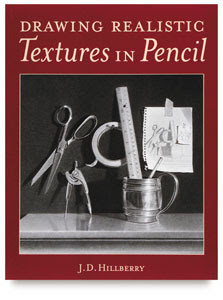
Book Review: Drawing Realistic Textures in Pencil

On her Making a Mark Blog, Katherine Tyrrell has invited all artists to join her October Big Drawing Book Review. I have read and done exercises from a number of art instruction books, so I thought I would join in.

Today I am reviewing Drawing Realistic Textures in Pencil by J.D. Hillberry, published by North Light Books in 1999 (ISBN 0-89134-868-9).

J.D. Hillberry is a self-taught artist who has discovered techniques for drawing subjects in a highly realistic way. He shares these techniques with readers in this book. Hillberry's website has examples of his work. Here is one of my drawings that utilizes his techniques.

This book will be of value to intermediate-to-advanced artists who wish to render subjects in a highly realistic manner using pencil and charcoal. I don't recommend this book for beginners, because it doesn't teach basic drawing skills.

In Chapter One, Hillberry gives a detailed explanation of the required art supplies.

In Chapter Two, Hillberry gives tips and techniques. He explains the effects that light and shadow have on form, gives tips on using value to render form, discusses blending techniques, explains how to effectively use charcoal and graphite together, and explains rubbing, indenting, and the use of frisket film.

In Chapter Three, Hillberry gives seven highly detailed step-by-step demonstrations. For example, he shows how to realistically draw glass, pitted metal, reflective metal, leather, wood, and faces. I was able to follow and apply Hillberry's step-by-step demonstrations. It tooks me a few tries to get good results, but this is because the techniques require practice, not because the instruction is poor.

In Chapter Four, Hillberry gives two more step-by-step demonstrations. One is a still life that contains a number of different textures and one is a cat on a ledge. The still life is on the cover of the book.

In order to use all of Hillberry's techniques, you will need a variety of pencils, charcoal, and miscellaneous materials such as frisket film and a chamois. You will need to make an initial investment if you don't already have a number of these items. Happily, compared to painting supplies, these materials are not expensive.

In order to get something out of any drawing book, you need to create art based on the techniques you are learning. Be forewarned that drawing in this style is very time-consuming.

I give this book 4 pencils. It does a good job at teaching what it aims to teach, for a low price. The book is attractive and the images are high-quality. Intermediate-to-advanced artists interested in creating highly realistic drawings will pick up new techniques to add to their repertoire.

I don't give the book 5 pencils because it does not meet Katherine's criterion: ... an essential book for anybody seriously interested in drawing and/or learning more about drawing. The book is not for those who are primarily interested in painterly approaches to drawing. One can create outstanding drawings without ever using the techniques discussed in this book. So I cannot say everyone needs to read this book.